
Handicap betting represents one of the most strategic forms of sports wagering available today. It exists to balance mismatched competitions by assigning virtual advantages or disadvantages to competing sides. Understanding its mechanics separates informed bettors from those who leave money on the table. The distinctions between Asian and European formats alone can significantly alter outcomes and returns. What follows breaks down exactly how this system operates.
Key Takeaways
- Handicap betting levels the playing field by giving virtual advantages or disadvantages to teams, creating more balanced wagering opportunities.
- Favored teams receive minus handicaps and must win by a set margin, while underdogs receive plus handicaps allowing tolerated losses.
- Asian handicap eliminates draw outcomes, whereas European handicap retains three possible results: win, draw, or loss.
- Half and quarter handicaps split stakes across multiple outcomes, refining potential returns and reducing the risk of voided bets.
- Handicap betting applies across multiple sports, including football, rugby, basketball, golf, and tennis, each using sport-specific margin systems.
What is Handicap Betting and Why Does It Exist?
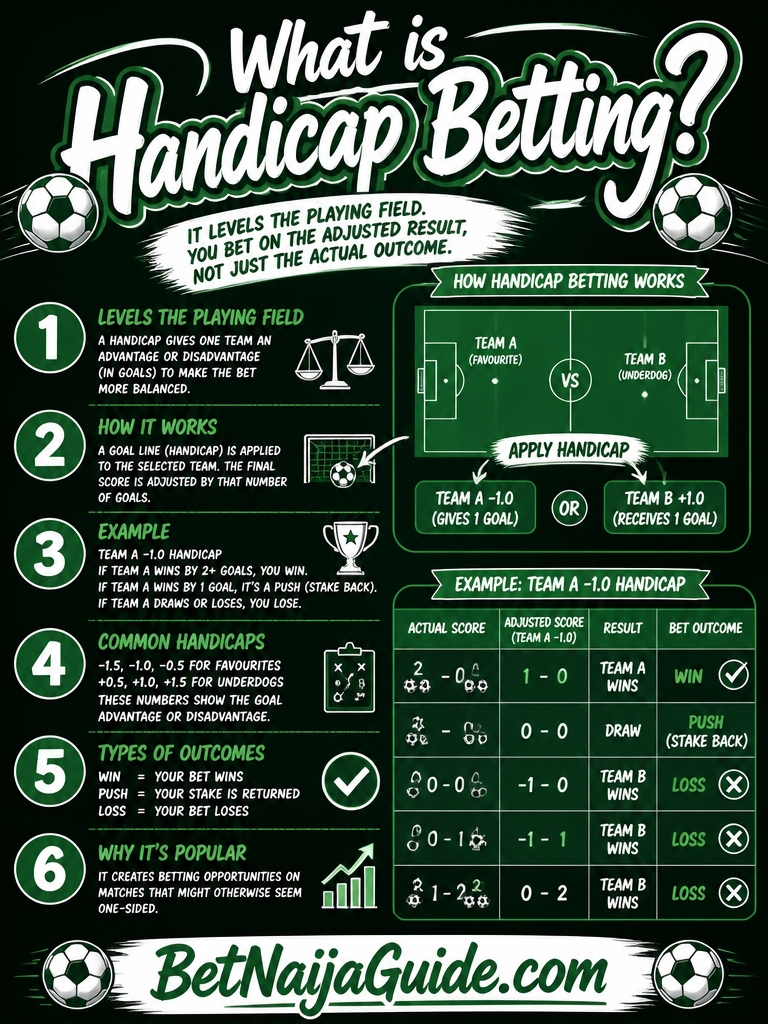
Handicap betting is a wagering format designed to neutralize competitive imbalances between opposing teams or players by applying virtual advantages or disadvantages to each side. This mechanism transforms lopsided matchups into genuinely competitive markets, expanding the range of viable wagering opportunities. The handicap benefits extend beyond simple odds adjustment — they compel bettors to engage more rigorously with performance data, including metrics like expected goals (xG), to refine their betting strategy. Two primary formats govern this market: the European handicap, which retains a draw outcome, and the Asian handicap, which eliminates it entirely for a binary result. A team carrying a -1 handicap must win by two or more goals, while a +1 handicap permits a win or draw for a successful wager.
How Handicap Betting Odds Actually Work?
Understanding how handicap betting odds are structured requires examining the relationship between perceived team quality and the margins bookmakers impose to balance their markets. Odds calculation begins with evaluating each team’s relative strength, then assigning handicaps that reflect realistic performance expectations.
Favored teams receive minus handicaps, requiring them to win by specified margins. Larger required margins typically produce more attractive odds, rewarding risk in betting strategies. Underdogs receive plus handicaps, permitting losses within the specified threshold while still securing winning bets, drawing value-conscious bettors.
Asian handicap formats eliminate draws entirely through half-point margins, reducing outcomes to two possibilities and fundamentally altering odds calculation methodology. Higher odds consistently signal greater difficulty overcoming assigned handicaps, providing bettors with transparent indicators of expected competitive difficulty when constructing informed betting strategies.
The Main Types of Handicap Bets Explained
Several distinct formats define handicap betting markets, each carrying unique structural characteristics that influence how outcomes are determined and how odds are priced. Asian Handicap eliminates draws entirely, forcing bettors to assess team performance against a defined margin. European Handicap preserves three possible outcomes—win, draw, or loss—offering bettors broader structural flexibility. Whole number handicaps introduce refund scenarios when adjusted scores produce draws, directly affecting betting strategies around risk management. Half and quarter handicaps split stakes across multiple outcomes, providing precision in how returns are calculated. Three-way handicap betting evaluates performance differentials rather than final scores, adding analytical depth to outcome assessment. Each format demands a distinct strategic approach, requiring bettors to understand structural mechanics before committing funds to any particular market.

Handicap Betting Across Different Sports
Across different sports, handicap betting adapts its structural mechanics to reflect each discipline’s scoring systems, competitive dynamics, and performance variables. Football handicap systems apply virtual goal margins, rugby points structures account for high-scoring environments, basketball spreads clarify expectations in mismatched contests, golf strokes adjust for skill differentials across rounds, and tennis advantages operate at set or game levels.
| Sport | Handicap Mechanism |
|---|---|
| Football | Virtual goal margins |
| Rugby | Points-based head starts |
| Basketball | Point spreads |
| Golf | Stroke adjustments |
Each mechanism serves a distinct function: normalizing competition, sharpening betting value, and expanding strategic options. Tennis advantages further illustrate how handicap frameworks scale across tournament tiers, granting bettors meaningful advantage regardless of competitive imbalance.
Asian Handicap vs. European Handicap: Key Differences
Handicap betting’s structural adaptations across sports set the stage for a more granular distinction: the difference between Asian and European handicap systems. The Asian Strategy eliminates draws entirely, employing non-integer handicaps like +0.5 or -1.5 to guarantee decisive outcomes. When whole-number handicaps apply, bets may be voided, offering bettors partial risk protection. This appeals to those prioritizing reduced exposure. The European Strategy, conversely, retains three possible outcomes—win, loss, or draw—mirroring traditional betting formats. Whole-number handicaps mean exact matches result in stake refunds. Where the Asian Strategy attracts risk-conscious bettors seeking binary resolution, the European Strategy suits those valuing outcome diversity and conventional structure. Both systems offer distinct strategic advantages, making the choice largely dependent on a bettor’s risk tolerance and preferred methodology.