
A betting slip serves as the official record of a wager, containing critical details that determine a bettor’s potential winnings or losses. Misreading even one element can lead to costly errors. Understanding each section — from odds and stake amounts to bet types and payout calculations — separates informed bettors from those who leave money on the table. The process is more structured than most assume.
Key Takeaways
- Identify key components on the slip: event selection, bet type, odds, stake amount, and potential payout to understand your wager fully.
- Learn odds formats—American, fractional, or decimal—as each presents potential payouts and winning probabilities differently.
- Verify the event details, including date and time, to ensure your bet is placed on the correct match.
- Confirm your bet type, whether a single, accumulator, or system bet, as this directly impacts your financial outcome.
- Cross-check the odds on your slip against live market rates to identify any discrepancies before finalizing your wager.
What Is a Betting Slip?
A betting slip is a document — physical or digital — that records the full details of a wager placed at a sportsbook, including the selected teams or players, bet type, odds, stake, and potential payout. Understanding betting definitions and wager types is fundamental to interpreting what the slip communicates. The document confirms the chosen market, displays the associated odds, and calculates the total return based on the stake entered. It serves as a binding record between the bettor and the sportsbook, ensuring both parties are aligned on the terms of the wager. Errors on a slip — whether from misreading odds or selecting the wrong market — can result in costly outcomes. Reviewing every detail before confirming the bet is a non-negotiable step in responsible wagering.
Key Sections on Every Betting Slip
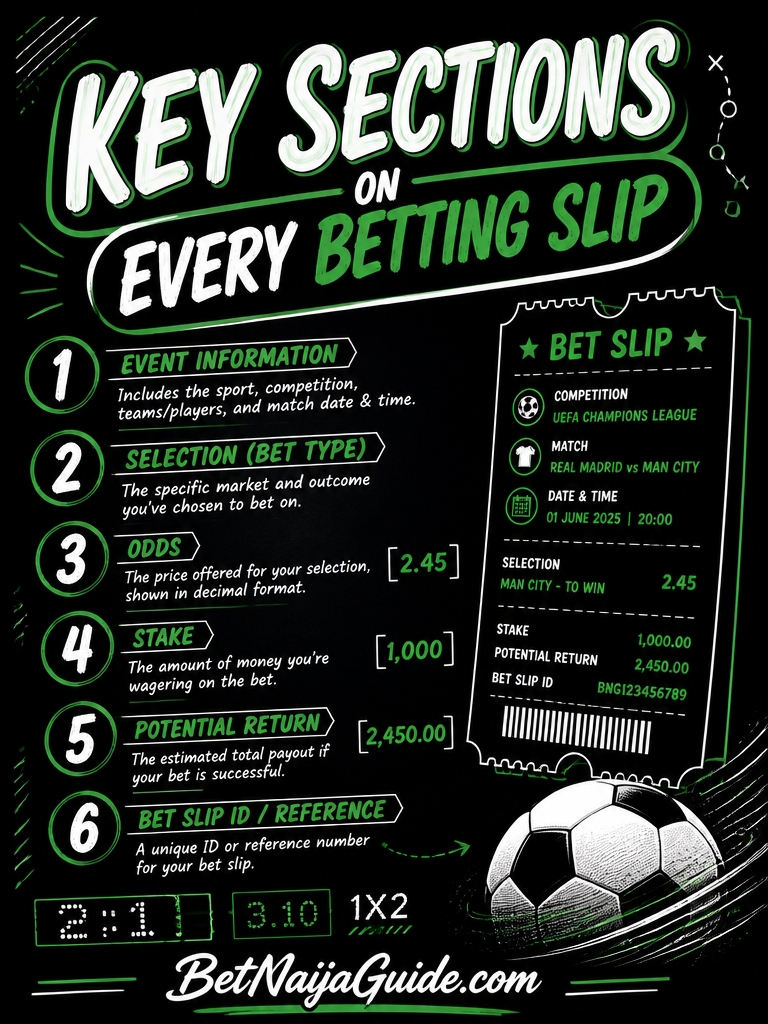
Every betting slip contains several crucial components that allow a bettor to evaluate a wager at a glance. The selected event, bet type, and associated odds work in tandem to define the precise nature of the wager, while the stake and potential return clarify the financial parameters. Mastering the relationship between odds and stakes is fundamental, as these two elements together determine both risk exposure and expected profit.
Essential Slip Components
Betting slips contain several key components that bettors must identify to assess any wager accurately. Understanding bet slip fundamentals allows bettors to arrive at knowledgeable choices without ambiguity. The chosen selection displays the specific team or player involved, while the odds section reflects potential payout and winning probability. Familiarity with betting terminology guarantees bettors correctly interpret whether they’re placing singles, accumulators, or prop bets, each carrying distinct structural implications. The stake amount must remain clearly visible, establishing the precise financial risk undertaken. Event date and time confirmation prevents costly errors, including missed opportunities or misdirected wagers. Each component functions interdependently, forming a complete financial document that demands careful scrutiny. Bettors who master these elements maintain full control over their wagering choices, eliminating unnecessary confusion and potential financial exposure.
Reading Odds and Stakes
Reading odds and stakes represents the most financially consequential skill a bettor develops when interpreting any slip. Odds formats — American, fractional, or decimal — each communicate potential payout differently, requiring bettors to recognize which system applies before calculating returns. Misreading the format directly distorts expected profit projections.
Stake impact operates with equal significance. The displayed stake reflects total money committed, functioning as the multiplier against displayed odds. A higher stake amplifies both potential returns and exposure to loss, making accurate stake verification non-negotiable.
Bettors must cross-reference displayed odds against current market rates. Discrepancies between slip odds and live market odds signal outdated or incorrect information, compromising betting strategy. Verifying both figures — odds format and stake amount — before submission protects financial decision-making and guarantees the slip accurately reflects intended wager conditions.
How to Read Betting Odds on Your Slip?
Most betting slips display odds in one of two primary formats: American or decimal. Understanding odds formats and implied probabilities empowers bettors to assess risk and potential returns accurately.
| Odds Format | Example |
|---|---|
| American (Negative) | -150: Wager $150 to win $100 |
| American (Positive) | +200: Wager $100 to win $200 |
| Decimal | 2.00: $100 bet returns $200 total |
| Implied Probability (Favorite) | Lower odds = Higher probability |
| Implied Probability (Underdog) | Higher odds = Lower probability |
Negative American odds identify favorites, requiring larger wagers for smaller returns. Positive odds signal underdogs, offering greater payouts for equivalent stakes. Decimal odds simplify calculations by displaying total returns per unit staked. Confirming that slip odds correspond with the specific bet type placed remains crucial.
Single, Accumulator, or System: Know Your Bet Type
Every bet placed falls into one of three structural categories: single, accumulator, or system. Betting clarity begins with understanding how each format operates and what it demands.
- Single bets offer straightforward wagers — one selection, one outcome, one payout calculation based solely on odds multiplied by stake.
- Accumulator strategies chain multiple selections together, compounding odds for higher returns, but requiring every selection to win.
- System bet benefits emerge through flexibility — formats like Trixie, Patent, and Yankee allow partial wins to still generate returns.
Each structure carries distinct winning conditions and payout rules. Misidentifying a bet type compromises strategic decision-making and financial expectations. Reading the bet type field on any slip is non-negotiable for informed, autonomous wagering.
How to Verify Your Stake and Potential Payout
After identifying the bet type, the bettor must confirm that the stake amount displayed on the slip matches the intended wager, as any discrepancy directly affects the potential payout. For positive odds, the total payout is calculated by multiplying the stake by the odds and adding the original stake; for negative odds, the stake is divided by the absolute odds value before the stake is added. A $100 bet at +200 odds, for example, yields a $300 total payout, making precise verification of both the stake and odds vital before the bet is finalized.
Confirming Your Stake Amount
When reviewing a betting slip, one of the most critical steps is verifying that the stake amount displayed matches the intended wager, as even minor discrepancies can substantially alter the potential payout. Stake confirmation guarantees full control over financial exposure before committing.
Key considerations for stake adjustment and verification:
- Cross-reference the displayed stake against the intended wager amount before proceeding.
- Utilize sportsbook modification options — many platforms permit stake adjustment directly on the slip.
- Recalculate potential payouts manually using the appropriate odds format to confirm accuracy.
Bettors who treat stake confirmation as non-negotiable protect themselves from costly errors. Since some platforms auto-populate stakes from previous sessions, independent verification remains vital. Confirming the stake before finalizing preserves both financial autonomy and wagering accuracy.
Calculating Potential Payout
Calculating potential payout begins with confirming the stake amount — the precise sum being wagered. Effective stake management guarantees accurate payout calculations before any bet is confirmed.
For negative moneyline odds, the formula (100 / Odds) x Stake determines profit. A $100 bet at -150 odds yields approximately $66.67 in profit. For positive moneyline odds, the formula (Odds / 100) x Stake applies. A $100 bet at +200 odds generates $200 in profit, producing a $300 total payout — stake plus winnings combined.
Bettors must cross-check odds displayed on the betting slip against expected payout calculations to eliminate discrepancies before confirmation. Misaligned figures indicate errors requiring immediate correction. Precision at this stage protects financial outcomes and guarantees every wager reflects the bettor’s intended risk-to-reward ratio.
Common Betting Slip Mistakes and How to Avoid Them
Misreading a betting slip can translate directly into financial loss, making error prevention a critical discipline for any bettor. Betting slip errors compound quickly when fundamental checks are skipped before confirming a wager. Avoiding losses requires systematic verification of three crucial elements:
- Selection accuracy — Confirm the correct team or player appears on the slip, as a single misidentification can drain a bankroll unexpectedly.
- Odds verification — Cross-reference displayed odds against current market odds, since discrepancies frequently emerge during the submission process.
- Market and stake confirmation — Distinguish precisely between markets such as match winner versus handicap, and audit the entered stake amount to eliminate accidental high-value commitments.
Additionally, understanding whether the slip constitutes a single, accumulator, or system bet determines how outcomes interact financially.
What to Do After You Place Your Bet?
Once a bet is confirmed, the bettor’s immediate responsibility shifts to verification — reviewing the slip to ascertain the selection, odds, stake, and potential payout all reflect the intended wager before the event begins. Betting confirmation is not merely procedural; it serves as the final safeguard against costly errors.
Beyond verification, the bettor should note the event date and kick-off time, then review applicable settlement rules to understand how disputes or edge cases are resolved. Familiarity with cash-out options grants strategic flexibility, allowing early withdrawal if circumstances shift.
Equally critical is emotional management. Bettors who regulate their emotional state prior to the event maintain sharper judgment regarding cash-out decisions and future wagering, reducing impulsive behavior and preserving long-term autonomy over their betting activity.