
Over/under betting represents one of the most straightforward wagering formats in sports gambling, yet most bettors misunderstand its deeper mechanics. Oddsmakers do not simply predict a score — they engineer a number designed to split public money. Understanding that distinction changes everything about how a bettor should approach totals. What follows breaks down exactly how this market operates, where the edges exist, and why even experienced bettors consistently leave money behind.
Key Takeaways
- An over/under bet is a wager on whether the combined score of two teams will exceed or fall short of a set line.
- Standard odds for over/under bets are typically 1.9 (10/11), meaning a $110 wager yields a $100 profit.
- If the final score exactly matches the set line, a push occurs, and all wagers are fully refunded.
- Oddsmakers adjust lines based on injuries, weather conditions, betting patterns, and sharp bettor influence to maintain balanced wagering.
- Psychological biases, like optimism bias, often drive bettors toward overs, creating potential value in under bets.
What Is an Over/Under Bet?
An over/under bet, commonly referred to as a total bet, is a wager on whether the combined scores of two competing teams will exceed or fall short of a line established by oddsmakers. This over/under terminology applies broadly across popular sports, extending beyond total points to individual player statistics such as assists or rushing yards. Standard odds typically begin at 1.91 in decimal format (or 10/11 in fractional format), requiring a £110 wager to yield £100 in profit. Should the actual combined score precisely match the established line, the bet results in a push, triggering full refunds on all wagers. Sportsbooks retain the flexibility to adjust totals in response to betting patterns, injury reports, or imbalanced wagering activity, ensuring competitive and balanced markets for bettors seeking informed wagering opportunities.
How Over/Under Bets Actually Work?
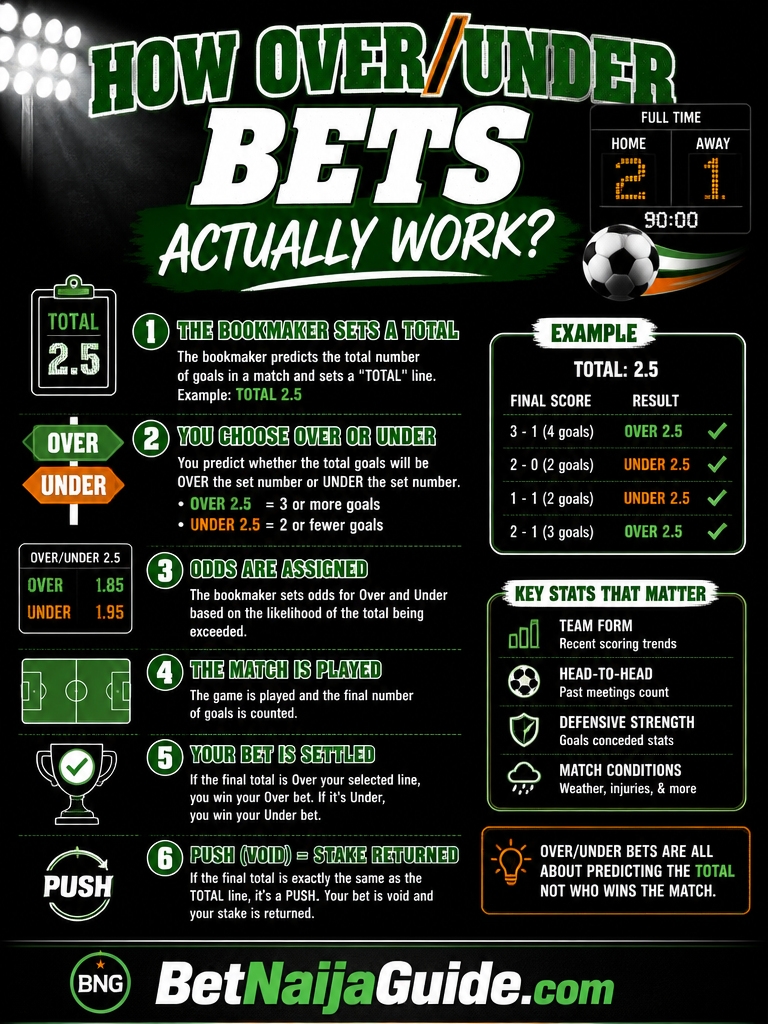
When placing an over/under bet, a bettor predicts whether the combined final score of both teams will exceed or fall short of the line established by oddsmakers. A correct prediction pays out at decimal odds of 1.9 (or fractional odds of 10/11), meaning a £100 wager returns £190 in total (£90 profit), while an incorrect prediction results in the full loss of the wagered amount. A third outcome exists when the final score lands precisely on the line, producing a “push” that triggers a full refund of all wagers placed on that total.
Defining the Basic Mechanics
Over/under betting operates on a straightforward premise: oddsmakers establish a projected total score for a given game, and bettors wager on whether the actual combined score will exceed or fall short of that number. Game dynamics and scoring trends directly shape these lines, with sportsbooks adjusting totals to reflect team efficiency, injuries, and pace.
| Outcome | Result |
|---|---|
| Score exceeds total | Over bet wins |
| Score falls short | Under bet wins |
| Score equals total | Push — refund issued |
| Overtime scored | Counts toward total |
| Standard odds | Approximately -110 |
Lines shift when betting becomes imbalanced, ensuring sportsbooks maintain balance. Bettors who understand these mechanics gain a structural advantage when evaluating whether a game’s final score aligns with established projections.
Winning and Losing Conditions
Most over/under bets resolve under one of three conditions: the combined score exceeds the total, falls short of it, or lands exactly on it. Bettors backing “Over” win when combined scoring surpasses the set line; “Under” bettors win when it falls below. When final scores match the total precisely, a push occurs, returning all wagers without profit or loss.
Overtime scoring counts toward the final total unless explicitly stated otherwise, a critical detail for pushing limits in close contests. Standard odds sit at 1.91 (10/11), meaning a $110 stake returns $210 in total or $100 in profit. Informed betting strategies account for historical trends — unders have won approximately 51.7% of NFL games since 2016 — giving disciplined bettors a measurable, data-driven edge when evaluating each wager.
How Oddsmakers Set the Total?
Setting an accurate total requires oddsmakers to synthesize a wide range of data points before a game kicks off, tips off, or gets underway. Team performance serves as the foundation, with statistical analysis of offensive and defensive efficiency, recent form, and head-to-head history shaping initial projections. Injuries and player availability further refine these estimates, as absences directly impact scoring potential.
External factors likewise carry significant weight. Weather conditions in outdoor sports can suppress totals considerably, particularly in football. Typical NFL and college football totals fall in the 40s and 50s, while NBA totals commonly settle around the 220s. Once posted, lines shift in response to sharp bettor influence or heavy public action, ensuring balanced wagering on both sides.
Why Do Over/Under Lines Move?
Over/Under lines shift in response to several key variables, most significantly injuries to high-impact players, which reduce projected offensive output and prompt oddsmakers to lower the total. Adverse weather conditions in outdoor venues similarly compress scoring expectations, as wind, rain, or extreme cold demonstrably limit offensive efficiency. Beyond these situational factors, sharp bettors—whose historical accuracy commands respect from sportsbooks—can trigger rapid line movement when they place significant wagers, signaling a market correction that reflects their calculated assessments of a game’s likely total.
Injuries Affect Totals
Many factors can shift an over/under line, but few carry as much immediate weight as player injuries. The injury impact on scoring potential is immediate, forcing oddsmakers to recalibrate totals rapidly. A missing star quarterback, for instance, can drop a total by several points overnight.
Key injury-driven adjustments include:
- Offensive injuries lower totals, reflecting reduced scoring potential from diminished playmaking capacity.
- Defensive injuries raise totals, as weakened defensive units typically surrender higher point outputs.
- Sharp bettor response exploits injury news quickly, targeting unders when secondary players assume primary roles.
Line movements following injury announcements reveal both oddsmaker recalculations and public sentiment shifts, creating exploitable windows for informed bettors who monitor roster news diligently.
Weather Impacts Lines
While injuries represent an internal roster variable, external environmental conditions carry equal disruptive force on over/under lines. Weather forecasting has become a crucial analytical tool for sportsbooks, which monitor meteorological data closely before adjusting totals. Rain, snow, and heavy winds suppress scoring averages by limiting offensive execution — particularly passing efficiency in football. A forecasted snowstorm can shift an NFL total by several points, reflecting anticipated limitations on both offenses. Oddsmakers respond swiftly, moving lines before sharp bettors exploit the discrepancy. Strategic adjustments cascade further, as teams themselves modify game plans under adverse conditions, compressing expected output. Bettors tracking real-time weather updates gain a measurable edge, particularly when line movement lags behind forecast changes, creating temporary pricing inefficiencies worth exploiting before sportsbooks recalibrate.
Sharp Bettors Drive Movement
Sharp bettors represent perhaps the most immediate trigger for over/under line movement, as sportsbooks treat their wagers as high-signal information rather than routine betting action. Their betting strategies reflect deep research, experience, and mathematical modeling that sportsbooks respect and respond to swiftly.
When sharp bettors act on a total, sportsbooks adjust lines rapidly to limit exposure. Three key reasons explain their influence:
- Their capital volume can significantly skew payout obligations on a single outcome.
- Their betting strategies historically demonstrate higher accuracy than public wagering patterns.
- Their coordinated timing can expose vulnerabilities in posted totals before adjustments occur.
Unlike casual bettors, sharp bettors force sportsbooks into reactive positions, making line integrity dependent on how quickly oddsmakers can identify and respond to professional wagering activity.
How Much Can You Win on an Over/Under Bet?
The amount a bettor can win on an over/under bet depends primarily on the odds attached to each side of the total. Standard payout calculations begin at 1.91 (10/11), requiring $110 wagered to return $100 in profit. Adjusted juice shifts these figures considerably, affecting betting strategies across the board.
| Odds | Bet Amount | Profit |
|---|---|---|
| 1.91 (10/11) | $110 | $100 |
| 1.83 (5/6) | $120 | $100 |
| 2.00 (1/1) | $100 | $100 |
When a total sits at 47.5 and the over lands at -110, a $100 wager returns $90.91 in profit. At -120, that same return requires $120 risked. Even-money unders at +100 offer dollar-for-dollar returns, providing bettors maximum flexibility when evaluating total lines.
Over/Under Bets vs. Point Spread Bets
Two of the most common wager types in sports betting—over/under totals and point spreads—differ fundamentally in what they ask bettors to predict. Understanding over/under fundamentals versus point spread intricacies clarifies which bet suits a given strategy.
Key distinctions include:
- Focus: Over/under bets assess combined scoring; point spreads measure the winning margin of a favored team.
- Line movement: Over/under lines shift based on public betting trends and team efficiencies; point spreads adjust around injuries and performance changes.
- Vigorish: Both typically carry -110 odds, though payout structures reflect different outcome assessments.
Point spread odds quantify perceived team skill gaps, while over/under totals incorporate offensive efficiency, defensive strength, pace, and weather. Each bet type demands a distinct analytical framework.
Psychological Biases That Affect Over/Under Betting
Beyond statistical models and line analysis, psychological biases exert a measurable influence on over/under betting behavior. Cognitive biases consistently distort decision-making, often to a bettor’s financial detriment.
Optimism bias draws bettors toward overs, fueled by enthusiasm surrounding high-scoring outcomes. Simultaneously, loss aversion discourages under wagers, as bettors fear missing an entertaining, high-scoring game. These cognitive biases compound through herd mentality, where bettors follow public trends, forcing sportsbooks to adjust lines accordingly.
The resulting betting patterns create exploitable inefficiencies. Research confirms that unders win more frequently, largely due to public expectations systematically inflating totals. Bettors who recognize these psychological tendencies gain a measurable edge, making decisions grounded in statistical reality rather than emotional impulse—exercising the disciplined independence necessary for long-term profitability.
Smart Strategies for Betting Totals
Several proven strategies exist for bettors seeking a measurable edge when wagering on totals. Statistical analysis reveals unders have won approximately 51.7% of NFL games since 2016, providing a foundational baseline. Understanding team dynamics—defensive strength, offensive efficiency, and recent form—further sharpens total predictions.
Three critical strategies include:
- Weather monitoring: Adverse outdoor conditions historically suppress scoring, shifting value toward unders.
- Sharp money tracking: Significant line movement signals respected bettors influencing outcomes, warranting attention.
- Alternative markets: Team totals and player props allow diversified positioning beyond standard game totals.
Bettors who combine rigorous statistical analysis with situational awareness of team dynamics consistently identify mispriced lines. Freedom in wagering comes from disciplined, data-driven decisions rather than emotional or uninformed speculation.
What Happens When the Score Lands Exactly on the Total?
One specific outcome that bettors must understand is the push, which occurs when the final combined score of a game matches the over/under line exactly. When score ties align with the set total, betting refunds are issued to all parties, regardless of whether they wagered on the over or under. This outcome applies uniformly across bet types, including game totals and player props.
Sportsbooks lessen push frequency by setting lines at half-points, such as 46.5, which eliminates the possibility of an exact match. When whole-number lines are offered, on the other hand, pushes remain a legitimate possibility, particularly in lower-scoring sports like football. Bettors should account for this scenario when evaluating lines, as a push neither generates profit nor incurs loss, simply returning the original wager.