
Bookmakers do not guess. Every price displayed on a betting market is the product of statistical modeling, liability management, and competitive positioning. Odds shift for reasons that extend far beyond simple probability. Understanding the mechanics behind these numbers reveals a system far more deliberate than most bettors ever consider — and knowing how it works changes everything about how one approaches a wager.
Key Takeaways
- Betting sites set initial odds using statistical models that factor in team form, player injuries, weather conditions, and historical performance data.
- An overround inflates implied probabilities beyond 100%, embedding a profit margin that ensures bookmaker profitability regardless of the outcome.
- Odds shift when heavy one-sided betting creates liability imbalances, prompting bookmakers to shorten prices and rebalance their exposure.
- Sharp bettors placing large, data-driven wagers can trigger simultaneous odds adjustments across multiple sportsbooks, known as steam moves.
- Automated algorithms now update odds in under 500 milliseconds, enabling instant reactions to score changes, injuries, and market conditions.
What Bookmaker Odds Actually Mean?
Bookmaker odds function as a pricing mechanism that translates statistical probability into financial terms, embedding a structural advantage for the operator known as the overround. This margin guarantees total implied probabilities across all outcomes routinely exceed 100%, systematically favoring the house.
Odds interpretation requires understanding three primary formats. Decimal odds of 2.00 return $20 on a $10 wager. Fractional odds of 3/1 yield $3 profit per $1 staked. American odds of -110 indicate $110 risked for $100 profit.
Probability analysis reveals the distinction between bookmaker-assigned odds and genuine statistical likelihood. Real probabilities derive from performance data, injury reports, and historical outcomes. Bookmaker figures, nonetheless, reflect both analytical assessment and market positioning, creating embedded inefficiencies that informed bettors can potentially identify and exploit.
How Bookmakers Build Profit into Every Price?
Understanding how odds embed financial advantage requires examining the mechanics behind the overround, the structural tool bookmakers use to guarantee profitability regardless of which outcome occurs. By inflating implied probabilities beyond 100%, bookmakers establish a built-in profit margin on every market they offer. The vigorish reinforces this further, ensuring returns favor the house even when liability is evenly distributed across competing outcomes.
Bookmakers compound this advantage by monitoring betting psychology. Casual bettors driven by emotion rather than data create pricing inefficiencies that operators actively exploit. When public sentiment strays from statistical probability, bookmakers adjust odds dynamically, capitalizing on the imbalance. Early odds, continuously refined through injury updates and shifting volume, allow operators to optimize margins throughout an event’s lifecycle, maintaining structural profitability with surgical precision.
How Bookmakers Set Their Opening Odds?
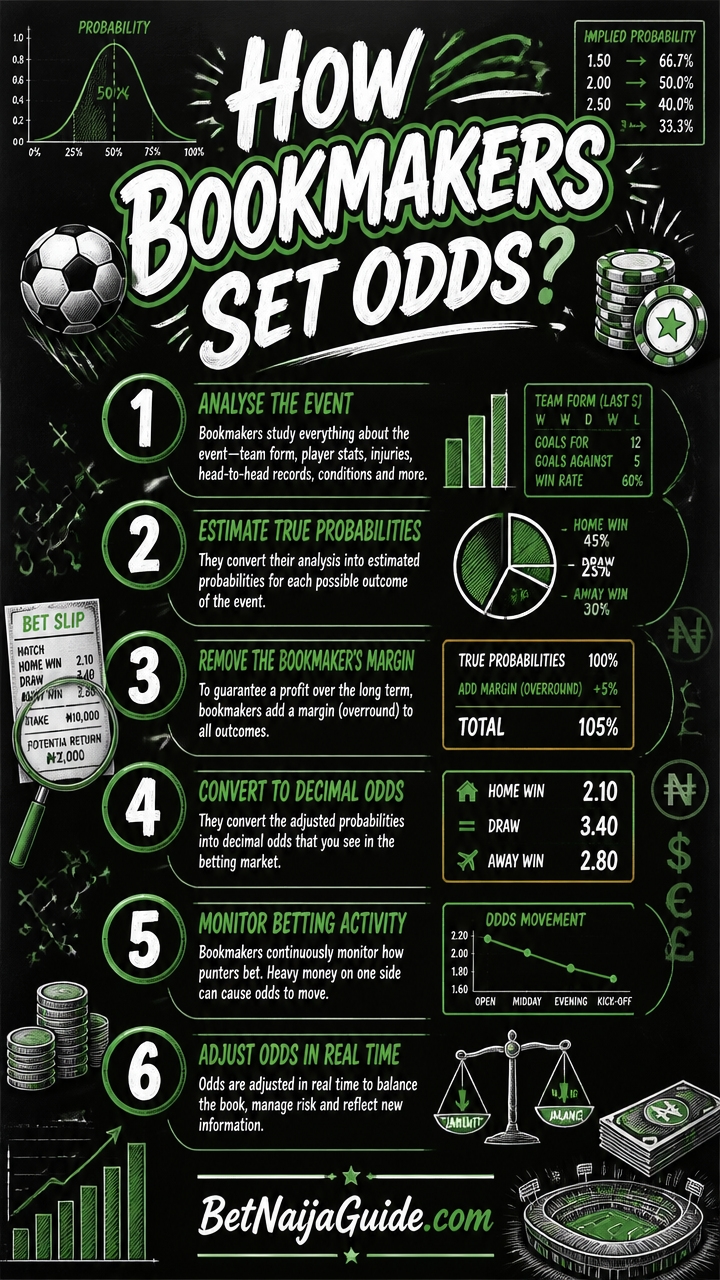
Setting opening odds is a structured process grounded in quantitative analysis rather than intuition. During initial analysis, odds compilers examine historical performance data, statistical models, and expert insights to calculate true outcome probabilities. This odds calculation incorporates multiple variables — team form, player injuries, weather conditions, and broader market sentiment — ensuring a thorough baseline assessment.
Crucially, bookmakers embed an overround into every price, pushing total implied probabilities beyond 100% to secure a built-in profit margin. Compilers simultaneously monitor competitor odds and betting market movements, calibrating their figures to remain competitive while reducing exposure to informed bettors.
Once markets open, opening odds rarely hold firm for long. Significant betting volume or late-breaking information, such as injury announcements, triggers rapid recalibration, reflecting the fluid nature of pricing in live markets.
Why Odds Change Before an Event
Odds rarely remain static between market opening and event commencement, shifting in response to several measurable forces. Heavy one-sided wagering compels bookmakers to shorten prices, rebalancing liability exposure. Team news, injury disclosures, and shifting public sentiment introduce information asymmetry, producing immediate market fluctuations that pricing models must absorb.
Sharp bettors amplify these movements considerably. Their substantial, informed wagers signal analytical consensus, prompting rapid adjustments that reflect genuine probability reassessments rather than mere betting psychology reactions. Automated trading algorithms reinforce this process, continuously scanning competitor odds and volume patterns, mirroring mechanisms observed in financial markets.
Ultimately, bookmakers adjust prices to redistribute action across both sides, minimizing concentrated risk. Each adjustment represents a calculated response to quantifiable data, not arbitrary decision-making.
Sharp Money, Public Money, and Line Movement
The forces driving line movement resolve into two distinct categories of betting activity: sharp money and public money. Sharp money strategies involve disciplined, data-driven wagers placed by professional bettors whose early, high-volume action compels bookmakers to adjust odds swiftly, reducing institutional exposure. These movements signal genuine probabilistic value rather than sentiment.
Public money psychology operates differently. Recreational bettors make emotionally driven decisions, gravitating toward popular teams and inflating odds on predictable outcomes. Bookmakers exploit this behavioral tendency by allowing lines to drift, extracting margin from casual wagers.
When sharp money targets an opposing side, steam moves emerge—simultaneous rapid adjustments across multiple sportsbooks. These coordinated shifts confirm professional consensus. Together, both forces shape lines that reflect statistical probability, market sentiment, and anticipated wagering behavior simultaneously.
How Different Betting Markets are Priced?
Across betting markets, pricing methodologies vary sharply depending on the structural characteristics of each market type. Moneyline mechanics center on direct win/loss probabilities, while spread calculations standardize lines at -110, embedding bookmaker margins efficiently. Totals assessment evaluates team scoring capacities, calibrating Over/Under lines to sustain profitability. Futures dynamics introduce compounding complexity, producing wider margins across extended prediction windows. Prop intricacies demand granular performance data to construct accurate individual-outcome pricing.
Key structural distinctions across market types:
- Moneyline prices direct outcomes without point adjustments
- Point spread standardizes -110 pricing across both sides
- Totals balance scoring projections against margin requirements
- Futures and props carry enhanced margins reflecting analytical complexity
Each market’s structural framework directly determines how bookmakers price risk and extract margin.
From Chalkboards to AI: How Odds Generation Has Evolved
The history of odds generation reflects a fundamental transformation in how bookmakers process and respond to information, moving from hand-calculated figures displayed on chalkboards to AI-driven systems capable of updating markets in under 500 milliseconds. In the manual era, odds were set by experienced traders who relied on intuition, historical knowledge, and relatively limited data, a process intrinsically slower and more susceptible to human error. Today, machine learning algorithms analyze vast datasets in real time, identifying patterns across thousands of variables to produce and continuously refine odds with a precision and speed that no human operation could replicate.
The Era of Manual Odds
Before algorithmic systems reshaped the industry, bookmakers operated within a labor-intensive framework where odds were calculated manually and posted on chalkboards for bettors to review. These manual processes demanded significant expertise, as compilers evaluated multiple variables independently.
Key factors informing chalkboard calculations included:
- Team performance metrics gathered through direct observation and recorded statistics
- Individual player data assessed for form, fitness, and historical output
- Situational variables such as weather, venue, and head-to-head records
- Experience-based judgment that compensated for gaps in available data
This framework, while methodical, carried essential limitations. Human error, processing speed, and data volume constraints restricted accuracy. However, skilled compilers developed refined instincts that produced competitive markets, establishing foundational principles modern automated systems still reflect in their probabilistic frameworks.
AI and Automated Odds
Decades of incremental technological advancement have culminated in a fundamental restructuring of how odds are generated, shifting authority from human compilers to algorithmic systems capable of processing data at scales no individual analyst could match. Machine learning models now parse extensive historical datasets, identifying patterns and recalibrating odds dynamically as betting volume and market conditions shift. During live events, automated systems execute updates in under 500 milliseconds, responding to real-time developments such as score changes or player performance fluctuations. Risk management capabilities embedded within these platforms continuously monitor for suspicious betting activity, enabling sportsbooks to protect financial stability without manual intervention. The result is a more accurate, responsive odds ecosystem that reflects genuine market sentiment while reducing operational vulnerabilities that previously existed under human-dependent compilation methods.