
Team form represents one of the most reliable data points available to sports bettors. It reveals momentum, confidence levels, and structural weaknesses that match odds often fail to capture. Yet most bettors misread form entirely, focusing on wins and losses while ignoring the metrics that actually predict outcomes. Understanding what the numbers genuinely indicate requires a more disciplined approach.
Key Takeaways
- Analyze the last five matches for wins, losses, and draws to identify consistency, momentum, and overall team confidence before betting.
- Assess offensive and defensive patterns by examining goals scored and conceded across recent matches to gauge team stability.
- Always separate home and away form, as performance can differ significantly depending on match location and travel factors.
- Account for injuries and suspensions, since key absences can drastically weaken a team beyond what raw form suggests.
- Compare statistical model predictions against bookmaker odds to identify value bets where the market may be mispriced.
What Does Team Form Actually Tell You?
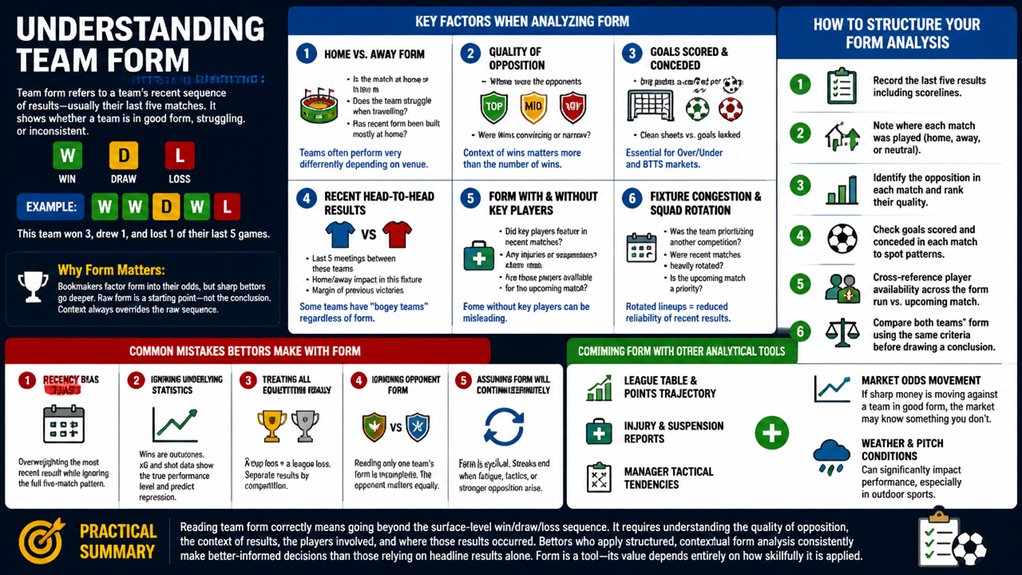
Team form serves as a quantitative snapshot of a side’s recent performances, typically spanning the last five to ten matches, and functions as one of the more reliable indicators of current competitive level. Effective form analysis extends beyond raw win-loss records, incorporating goals scored, goals conceded, and the caliber of opposition faced. A side posting three consecutive wins against bottom-table opponents tells a fundamentally different story than one defeating title contenders. Performance indicators such as injury reports and home-versus-away splits add further dimensional accuracy. Winning or losing streaks carry psychological weight, potentially influencing squad confidence heading into subsequent fixtures. Bettors who treat form as a multi-variable dataset rather than a simple tally gain a measurable analytical edge when evaluating probable outcomes.
Read the Last 5 Matches Before You Bet
Reviewing a team’s last five matches offers a focused snapshot of current performance, revealing whether a squad is riding a winning streak, mired in consecutive losses, or oscillating inconsistently. These recent results carry measurable weight in how bookmakers calculate odds, as sustained form—positive or negative—directly shifts probability assessments and betting lines. Patterns emerging from this five-match window, such as a defense conceding in every outing or a striker scoring in consecutive games, provide data points that sharpen predictive accuracy before placing a wager.
Recent Match Performance Matters
Before placing a bet, examining a team’s last five matches provides the most reliable snapshot of current form. This window reveals wins, losses, and draws, exposing either consistency or instability. Offensive consistency becomes measurable through goals scored across these matches, while defensive stability emerges from goals conceded patterns.
Opponent quality within this sample matters significantly. Strong results against weaker sides carry less predictive weight than performances against comparable competition. Player injuries or suspensions during this period further complicate raw results, potentially distorting actual team capability.
Home and away splits within the last five matches likewise warrant attention. Teams frequently perform differently across these settings, making location a critical variable. Bettors who analyze these layered data points independently position themselves to make more informed, evidence-based decisions.
Spotting Winning and Losing Streaks
A five-match window functions as a diagnostic tool, revealing whether a team is riding psychological momentum or sliding toward collapse. Streak analysis requires more than counting wins and losses — opponent quality and margin of results carry equal weight. A team winning consecutive matches against elite competition signals genuine momentum impact, while a losing streak against weaker sides suggests deeper structural problems.
Bettors should distinguish between cosmetic streaks and meaningful ones. Three narrow defeats against top-ranked opponents tell a different story than three heavy losses against mid-table sides. Similarly, injury patterns within the streak period can explain sudden performance shifts.
Identifying the streak’s origin — tactical, personnel-based, or psychological — transforms raw data into actionable intelligence, giving bettors a sharper edge when evaluating a team’s true competitive trajectory.
How Form Shapes Betting Odds?
Form data from the last five matches feeds directly into how bookmakers calibrate their odds, compressing weeks of performance into probability estimates that shape betting markets. Rigorous form analysis examines goals scored, goals conceded, opponent quality, and home versus away splits — variables that collectively shift lines by meaningful margins.
A team riding a four-match winning streak against competitive opposition commands shorter odds than one recovering from a losing streak against weaker clubs. Bookmakers recognize these distinctions precisely.
Betting psychology complicates the equation. Public bettors frequently overreact to recent results, inflating or deflating odds beyond statistically justified levels. Identifying those distortions — where market perception strays from actual performance data — represents the core opportunity. Form, read correctly, exposes mispriced lines before the market corrects them.
Home vs. Away Form Changes Everything
When analyzing team form, one of the most critical distinctions to examine is the split between home and away performance. Home advantage is quantifiable, with win rates ranging from 55% to 70% across major leagues, driven by familiar conditions and crowd support. The travel impact on away teams materializes through fatigue, disrupted routines, and reduced player sharpness, collectively suppressing points-per-game averages on the road.
Bettors who ignore this split risk misreading overall form entirely. A team appearing strong based on cumulative results may mask a historically poor away record. Conversely, a side with modest overall statistics could carry a dominant home record. Examining this home-away distinction separately, factoring in injuries and fixture location, delivers far more precise predictive insight than aggregate form alone.
How Head-to-Head Records Shape Betting Decisions?
Beyond home and away splits, head-to-head records introduce another layer of predictive data that reshapes how bettors evaluate upcoming fixtures. Historical performance between two sides reveals consistent dominance patterns that aggregate standings often obscure. Match location within those prior meetings matters significantly — a team’s record at a specific venue can differ sharply from its general home or away statistics.
Injuries and current form must be weighed alongside these records to avoid overreliance on historical data alone. Specific match conditions — weather, referee tendencies — may have skewed previous results, requiring bettors to frame each data point carefully. Psychological dynamics, including established rivalries or confidence built through repeated victories, further influence outcomes. Bettors who cross-reference these variables against current conditions gain a measurably stronger analytical foundation for their decisions.
Injuries and Suspensions That Distort Team Form
Few variables distort perceived team form more sharply than injuries and suspensions, as both remove key contributors from lineups and expose structural weaknesses that aggregate statistics conceal. Player impact becomes measurable when lineup changes force coaches into suboptimal selections, reducing tactical cohesion and output quality.
| Factor | Effect on Team | Betting Implication |
|---|---|---|
| Key injury | Weakened attack/defense | Reassess favorites |
| Accumulative yellows | Suspension risk rises | Monitor card counts |
| Long-term absence | Declining form curve | Fade inflated odds |
| Multiple absences | Consistency breakdown | Identify value odds |
| Late fitness tests | Uncertain lineup | Delay bet placement |
Tracking player availability before markets close allows bettors to exploit odds that haven’t yet adjusted to confirmed absences, creating measurable edges independent of public perception.
How to Combine Form Data Into a Betting Strategy?
Combining form data into a coherent betting strategy requires synthesizing multiple variables into a structured evaluation framework rather than reacting to isolated statistics. Effective data analysis transforms raw performance indicators into actionable betting strategies.
- Review recent five-game sequences to establish current momentum and consistency patterns.
- Analyze key player metrics—goals, assists, and defensive records—to assess individual impact on team output.
- Cross-reference head-to-head records against current form to identify historically significant matchup tendencies.
- Incorporate contextual variables—injuries, suspensions, and home/away splits—to refine probability assessments.
Statistical models consolidate these data points, revealing value bets that surface when bookmaker odds fail to reflect true performance realities. Independent bettors who master this framework position themselves to make disciplined, evidence-based decisions rather than speculative ones.