
Most beginners who lose money betting on sports do not lose due to bad picks. They lose since they never controlled how much they wagered. Bankroll management separates disciplined bettors from those who go broke chasing losses. Understanding its core principles changes everything about how one approaches a wager — and what follows makes that case precisely.
Key Takeaways
- A sports betting bankroll is a dedicated fund kept separate from personal finances to maintain financial discipline and sustainability.
- Beginners should wager only 2-5% of their bankroll per bet to prevent losing funds during cold streaks.
- Setting a consistent unit size, such as $20 on a $1,000 bankroll, helps beginners manage risk effectively.
- Flat betting offers simplicity for beginners, while percentage-based models provide adaptive risk management as experience grows.
- Tracking bets using apps or spreadsheets enables evidence-based decisions by monitoring key metrics like ROI and win rate.
What is a Sports Betting Bankroll?
A sports betting bankroll is a designated pool of funds set aside exclusively for wagering activities, kept entirely separate from personal finances. This deliberate fund allocation guarantees bettors operate solely with disposable income, eliminating the risk of compromising crucial financial obligations.
Bankroll size varies considerably based on experience and risk tolerance. Beginners typically start with $200, while seasoned bettors may allocate $10,000 or more. Establishing this boundary at the outset of a betting season provides structural discipline, reducing impulsive deposits following losses.
Effective bankroll management directly supports long-term betting sustainability. By defining financial limits upfront, bettors preserve their capacity to endure inevitable losing streaks without catastrophic consequences. This foundational principle separates strategic, independent bettors from those who gamble recklessly without financial parameters.
Why Bankroll Management Makes or Breaks Beginners?
For beginners, bankroll management functions as both a financial safeguard and a behavioral framework, determining whether a new bettor develops sustainable habits or exits the activity prematurely through preventable losses. Restricting wagers to 2–5% of a dedicated betting fund—separate from personal finances—provides critical risk mitigation against inevitable losing streaks. Without this structure, cold streaks rapidly deplete funds and trigger impulsive decision-making.
Emotional control becomes similarly decisive. Beginners who track bets and monitor ROI replace reactive gambling with analytical evaluation, refining strategies rather than chasing losses. Defining a bankroll between $200 and $10,000 exclusively for betting reinforces financial boundaries, reducing exposure to addiction and financial strain. Ultimately, disciplined bankroll management transforms sports betting from an impulsive activity into a structured, strategy-driven pursuit with measurable long-term potential.
How to Set Your Betting Unit Size?
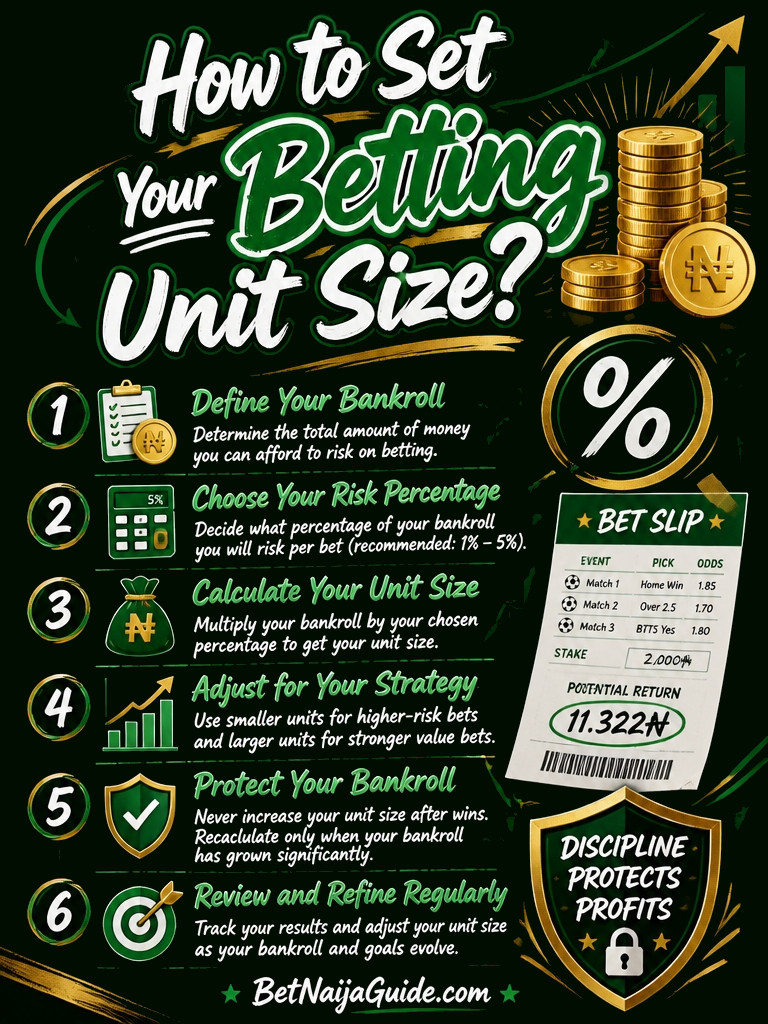
Once a dedicated bankroll is established, determining the appropriate betting unit size becomes the next operational decision that directly governs risk exposure on every individual wager. A sound betting strategy recommends allocating 2-5% of the total bankroll per unit, enabling sustainable long-term participation.
| Bankroll | Unit Size (2%) |
|---|---|
| $500 | $10 |
| $1,000 | $20 |
| $2,500 | $50 |
| $5,000 | $100 |
| $10,000 | $200 |
Proper risk assessment demands that beginners adopt flat betting initially, applying identical unit sizes across all wagers until recognizable patterns emerge. Tracking performance in units rather than dollar amounts delivers objective clarity about actual results. Confidence levels and specific odds may justify minor unit adjustments, but disciplined adherence to the established percentage protects the bankroll from catastrophic drawdowns.
Flat Betting vs. Percentage Models: Which Fits You?
Both flat betting and percentage-based models represent structurally distinct approaches to bankroll allocation, each carrying measurable trade-offs that make suitability contingent on a bettor’s experience level, risk tolerance, and operational discipline. Flat betting fixes wager size — say, $20 per bet on a $1,000 bankroll — delivering consistent, trackable results while reducing emotionally driven decisions. Percentage models apply a fixed stake rate, typically 2%–5%, recalibrating each wager relative to current bankroll size. A 3% stake on a $1,000 bankroll produces a $30 wager, automatically contracting during losing runs and expanding during growth. Flat betting favors simplicity and budget control; percentage models favor adaptive risk management. Neither method guarantees profitability — selection accuracy remains paramount. Bettors should track both systematically before committing to one framework.
Track Your Bets to Spot What’s Actually Working
| Metric | Poor Performance | Strong Performance |
|---|---|---|
| ROI | Below 0% | 5–7% |
| Win Rate | Under 45% | 52–55% |
| Bet Volume | Under 50 bets | 100+ bets |
Dedicated apps or spreadsheets capture odds, stakes, and results, enabling honest performance analysis across bet types and markets. Bettors who review this data regularly identify which strategies generate consistent edges versus which drain capital. Without this discipline, bankroll management remains guesswork rather than structured, evidence-based decision-making.