Millions of bettors worldwide unknowingly place wagers on unlicensed gambling sites each year, often uncovering the consequences only after suffering financial losses. The risks extend far beyond losing a bet. From frozen accounts to stolen identities, the dangers are both immediate and long-lasting. Understanding what truly happens behind the scenes of these unregulated platforms could be the difference between a protected wager and a financial disaster.
Key Takeaways
- Betting on an unlicensed site exposes you to state-level fines of $500 or more and potential federal financial penalties.
- Your deposited funds are completely unprotected, with no legal recourse if the operator seizes or withholds your money.
- Unlicensed sites can rig game outcomes without accountability, as no regulatory authority monitors their fairness standards.
- Your personal and financial data may be sold to third parties, increasing identity theft and fraud risks significantly.
- Courts will not enforce contracts with unlicensed operators, leaving you with no legal protection or dispute resolution options.
What Makes a Gambling Site Unlicensed?
Unlicensed gambling sites operate without regulatory oversight from a recognized governing authority, meaning they bear no legal obligation to uphold the consumer protections that licensed platforms must enforce. Unlicensed regulations — or the absence thereof — allow operators to bypass age verification, responsible gambling measures, and fair play standards. Many deliberately establish themselves in jurisdictions with minimal compliance requirements, effectively shielding their operations from scrutiny. Without accountability to a legitimate licensing body, these platforms impose arbitrary terms, manipulate withdrawal processes, and expose users to fraudulent practices. Players engaging with such sites forfeit legal recourse entirely, assuming full financial risk independently.
Legal Risks of Betting on an Unlicensed Site
Betting on unlicensed platforms carries tangible legal consequences that extend well beyond mere financial loss. Operating outside the established regulatory framework, these sites leave bettors exposed to state-level fines reaching $500 or more. The Unlawful Internet Gambling Enforcement Act further compounds financial penalties for U.S. citizens engaging offshore. Courts refuse to enforce contracts formed with unlicensed operators, stripping bettors of meaningful legal recourse. While actual prosecutions remain uncommon, criminal charges — typically minor offenses — remain possible. Both local and provider jurisdictions must authorize gambling for it to be lawful, a standard most offshore platforms consistently fail to meet.
How Unlicensed Sites Put Your Money at Risk?
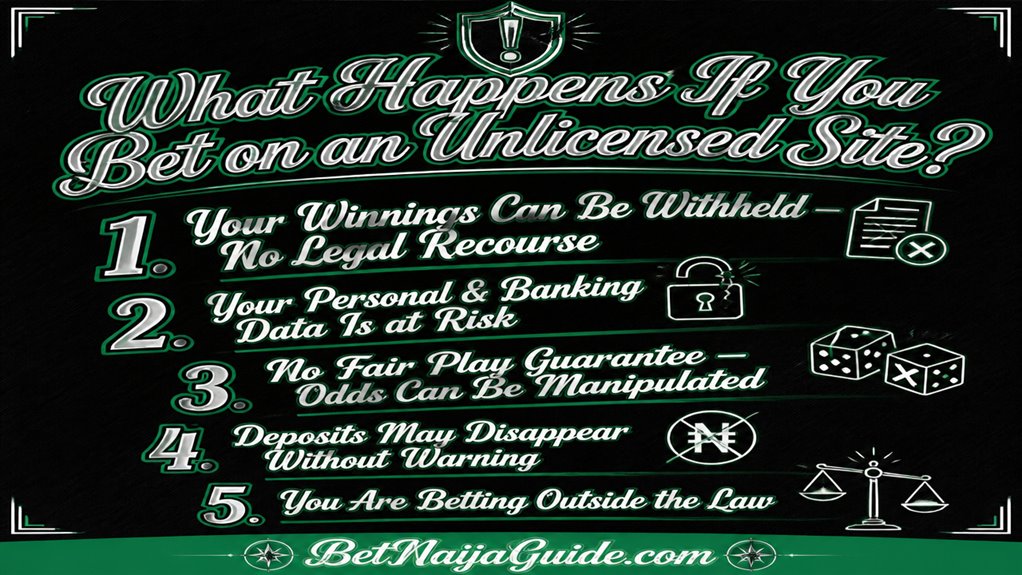
Unlicensed betting sites operate without regulatory oversight, leaving deposited funds entirely unprotected and subject to arbitrary seizure or denial of withdrawal. Without governing bodies enforcing fair play standards, these platforms face no accountability for rigging game outcomes in favor of the house. Players who fall victim to such practices have no legal recourse, effectively making any funds deposited into unlicensed platforms an unrecoverable financial risk.
No Fund Protection
One of the most serious financial risks associated with unregulated gambling platforms is the complete absence of fund protection for deposited money. Without licensing oversight, deposits remain entirely vulnerable to permanent loss. Unlike regulated operators bound by financial safeguards, unlicensed sites operate outside gambling legality, offering no institutional accountability. When platforms collapse or engage in fraud, fund recovery becomes virtually impossible. Players retain no legal standing to challenge operators or reclaim balances through regulatory bodies. This absence of structural protection fundamentally strips individuals of financial sovereignty, transforming what appears to be a straightforward transaction into an irreversible, unprotected financial exposure.
Rigged Games Risk
Beyond fund protection concerns, rigged game mechanics represent another severe financial threat on unlicensed platforms. Without regulatory oversight, operators freely manipulate algorithms, systematically eroding game integrity and eliminating genuine win potential. Independent audits, standard on licensed sites, are absent here, leaving players no mechanism to verify fairness. Deceptive programming favors the house disproportionately, ensuring consistent player losses. When grievances arise, no formal recourse exists. Player trust becomes irrelevant to unlicensed operators, who face zero accountability. For individuals prioritizing financial autonomy, these platforms represent calculated traps—environments deliberately engineered to extract money rather than provide legitimate, transparent competition.
Your Personal Data Is Never Safe on Illegal Sites
Illegal gambling sites routinely collect sensitive personal and financial data without implementing basic encryption protocols, leaving users acutely exposed to interception and exploitation. Without regulatory oversight, operators face no obligation to safeguard this information, and many monetize it by selling it to third parties on dark web markets without users’ knowledge or consent. Unlike licensed platforms subject to data protection laws, unlicensed sites operate in jurisdictions where accountability is virtually nonexistent, meaning victims of data theft have no legal mechanism for recourse.
Data Sold Without Consent
Among the most serious risks associated with unlicensed gambling platforms is the unregulated handling of personal data. Without legal oversight, operators exploit user information freely, undermining data privacy at every level. Third party sales occur routinely, often buried within deceptive terms users unknowingly accept.
Key consequences include:
- Banking details sold on black markets, enabling identity theft
- Personal information transferred to unknown third parties without disclosure
- No enforceable consent mechanisms protecting user rights
Licensed operators face strict data protection mandates. Unlicensed platforms face none. Users surrendering their information to these sites effectively forfeit control over their most sensitive personal details permanently.
No Encryption Protects You
The deliberate sale of user data by unlicensed platforms represents only one dimension of a broader security failure. Without proper encryption standards, personal and financial information transmitted through illegal sites remains fully exposed. The absence of SSL encryption leaves credit card details and identification vulnerable to interception by cybercriminals. These data vulnerabilities create direct pathways for identity theft and phishing attacks. Players have no legal recourse when breaches occur, absorbing financial losses independently. Those who value their autonomy must recognize that operating outside regulated frameworks strips away the fundamental protections individuals require to maintain genuine control over their personal information.
How to Tell If a Betting Site Is Unlicensed?
Identifying an unlicensed betting site requires attention to several key indicators that legitimate platforms consistently display. Site verification through regulatory authorities remains the primary method for confirming legitimacy.
Key warning signs include:
- Absence of responsible gaming logos or age restriction badges
- Claims of overseas regulation from authorities with questionable standards
- Cryptocurrency-only transactions, which compromise traceability and legal accountability
Unlicensed platforms frequently operate without functional customer support or dispute resolution processes, leaving bettors without recourse. Players prioritizing their autonomy must independently verify licensing credentials before committing funds, as these sites exploit jurisdictional gaps to evade accountability.
What to Do If You’ve Already Bet on an Unlicensed Site
Uncovering that one has placed bets on an unlicensed site demands immediate, methodical action to minimize financial and personal data exposure. Fund recovery strategies should begin with opting out of all bonuses, freeing tied-up deposits for potential withdrawal. Player rights, though limited on unregulated platforms, still permit pursuing withdrawals through trustworthy payment methods. Contacting customer support remains worthwhile in spite of limited accountability. Critically, closing the account and requesting personal data deletion protects against further exploitation. Funds may be permanently compromised given these operators’ unethical payout practices, underscoring why proactive, decisive steps must be taken without delay.