The Universal Reciprocity Certificate has fundamentally altered how regulated betting operates across Nigeria. Introduced following a landmark Supreme Court ruling in November 2024, it consolidates fragmented state-level licensing into a single, enforceable framework. For bettors, the implications extend beyond convenience. Questions surrounding tax obligations, platform legitimacy, and account verification now carry real financial consequences. Understanding exactly what the URC demands — and protects — requires a closer examination.
Key Takeaways
- The URC is a unified license allowing operators to run across all 22 FSGRN member states, offering bettors greater access to regulated platforms from January 2026.
- Bettors gain stronger protections under the URC, including anti-money laundering protocols, self-exclusion options, and secure payment systems preventing financial misconduct.
- A November 2024 Supreme Court ruling shifted gaming authority to states, meaning operators now need a URC for legal multi-state operations.
- New tax regulations effective January 2025 require licensed operators to withhold 5%-15% from winnings, varying by game type and state jurisdiction.
- Bettors should verify a platform’s URC status using the FSGRN database before engaging, as only URC-holding platforms operate legally after January 2026.
What Is the Universal Reciprocity Certificate?
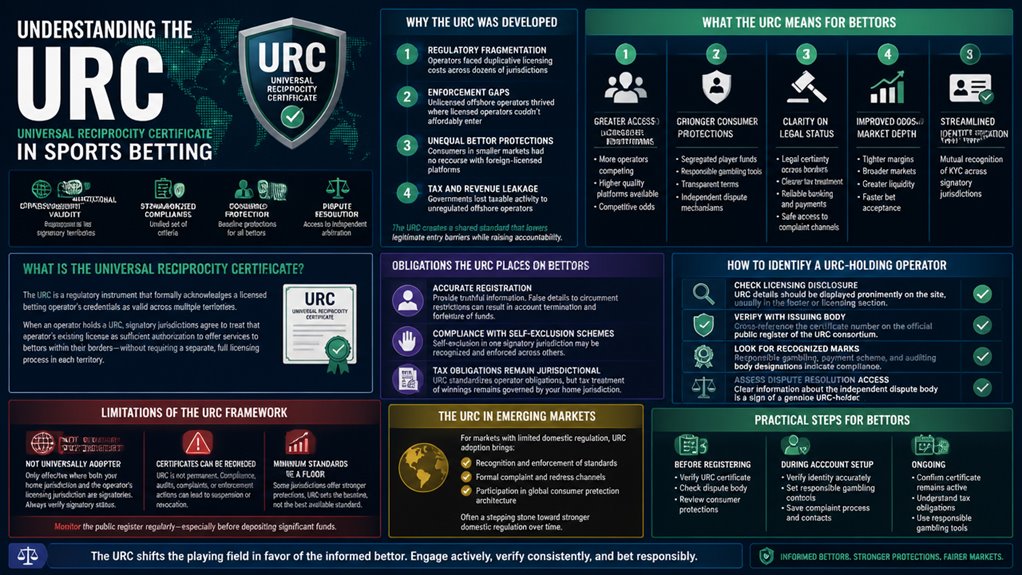
The Universal Reciprocity Certificate (URC) is a unified licensing instrument introduced by the Federation of State Gaming Regulators of Nigeria (FSGRN) that permits gaming operators to conduct business across all member states under a single authorization. Previously, fragmented dual licensing systems created regulatory inconsistencies and operational burdens. The URC benefits both operators and bettors by standardizing compliance requirements and eliminating redundant licensing processes. By consolidating authority under FSGRN, the licensing process becomes transparent and efficient, reducing barriers to entry for operators while ensuring bettors interact with consistently regulated platforms. Mandatory from January 1, 2026, the URC establishes a coherent, freedom-enabling regulatory framework nationwide.
How the November 2024 Supreme Court Ruling Changed Everything
On November 22, 2024, a landmark Supreme Court ruling fundamentally restructured gaming regulation in Nigeria by redefining lotteries and sports betting as a state responsibility, effectively nullifying the National Lottery Act 2005 outside the Federal Capital Territory. The regulatory impacts were immediate and sweeping. Federal licensing frameworks dissolved, replaced by the Federation of State Gaming Regulators of Nigeria, institutionalizing state autonomy over gaming operations. Individual states gained direct authority to govern licensing and compliance within their jurisdictions. Operators must now secure a Universal Reciprocity Certificate from state regulators, enabling multi-state operations under a single license while eliminating the fragmented federal oversight structure entirely.
How the URC Protects Bettors Across Nigeria?
Designed to unify regulatory standards across member states, the Universal Reciprocity Certificate fundamentally repositions bettor protection as a structural priority rather than an afterthought. Through rigorous fraud prevention mechanisms and bettor education initiatives, the URC dismantles conditions that previously permitted unlicensed platforms to exploit users.
- Anti-money laundering protocols and identity verification reduce fraudulent operator activity
- Responsible gaming measures and self-exclusion options safeguard vulnerable bettors
- Multi-state licensing expands access to regulated, trustworthy platforms
- An 11% gross gaming revenue tax discourages illegal operations
These provisions collectively shift power toward informed bettors operating within secure, transparent environments.
Which States Accept URC-Licensed Operators?
The URC is recognized across 22 member states of the Federation of State Gaming Regulators of Nigeria (FSGRN), with Lagos and Abuja among the most prominent adopters of the framework. Within these jurisdictions, URC-licensed operators benefit from a unified regulatory environment, eliminating the need for separate state-by-state licensing. Outside the FSGRN’s membership, nonetheless, the URC holds no standing, requiring operators to navigate distinct licensing requirements in non-member states to maintain full legal compliance.
Current FSGRN Member States
Currently, 22 Nigerian states operate under the Federation of State Gaming Regulators of Nigeria (FSGRN) framework, granting URC-licensed operators unified market access across these jurisdictions. FSGRN functions include standardizing regulatory compliance and eliminating redundant licensing barriers. Member advantages extend beyond operational efficiency, directly benefiting bettors through improved protections and transparent markets.
Key characteristics of FSGRN member states include:
- Recognized regulatory frameworks supporting cross-jurisdictional operator access
- Boosted revenue generation through streamlined licensing
- Strengthened player protection initiatives
- Full alignment with national legal standards
Lagos and Abuja represent prominent members, demonstrating how structured participation creates competitive, well-regulated gaming environments.
Non-Member States Considerations
While the Universal Reciprocity Certificate streamlines operations across 22 FSGRN member states, its authority does not extend to non-member jurisdictions, where independent licensing frameworks govern operator access. Operators seeking expansion beyond FSGRN boundaries encounter significant regulatory hurdles, as each non-aligned state enforces distinct compliance requirements. These operational challenges demand dedicated licensing efforts, increasing both administrative burden and market entry costs. For bettors, this fragmentation means URC-licensed operators may remain inaccessible in certain regions. Thorough market research becomes crucial—determining which non-member states accept URC-licensed operators directly influences where bettors can freely and legally engage with preferred platforms.
What Bettors Should Look for in a URC-Compliant Platform
When evaluating a URC-compliant platform, bettors should first confirm that the operator displays a valid Universal Reciprocity Certificate alongside its Federation of State Gaming Regulators of Nigeria (FSGRN) licensing details, as these credentials establish baseline legitimacy. Platform security merits equal scrutiny, requiring verification of robust identity checks, age verification protocols, and secure payment infrastructure—all mandatory compliance elements under regulations taking effect in January 2026. Transparency in financial operations further distinguishes credible platforms, particularly their adherence to the fixed 11% gross gaming revenue tax and the provision of detailed financial reporting to regulatory bodies.
Verifying URC Compliance Status
Bettors engaging with online gaming platforms in Nigeria bear a degree of responsibility in confirming that a given platform holds a valid Universal Reciprocity Certificate (URC), which serves as the foundational indicator of multi-state licensing authority and unified regulatory compliance. Understanding URC benefits while traversing compliance challenges requires systematic verification.
- Confirm FSGRN registration documentation is publicly accessible
- Review operational transparency disclosures regarding licensing authority
- Verify player protection mechanisms: identity verification, age restrictions, self-exclusion options
- Assess tax compliance with the 11% gross gaming revenue flat rate effective 2026
Platform Security and Transparency
Identifying a genuinely URC-compliant platform requires bettors to assess several interconnected security and transparency indicators rather than relying solely on a displayed certificate. Platform reliability hinges on robust data encryption, secure payment processing, and regularly updated licenses confirmed through independent audits. Transparency indicators include clearly written terms of service, accessible responsible gaming policies, and responsive customer support channels. These elements collectively establish user trust beyond superficial compliance markers. Platforms incorporating age verification and self-exclusion tools further demonstrate institutional accountability. Bettors prioritizing genuine operational integrity should evaluate these measurable criteria systematically, ensuring their chosen platform maintains substantive standards rather than merely symbolic certification.
How Identity Verification and AML Rules Affect Your Account?
The Universal Reciprocity Certificate (URC) introduces mandatory identity verification requirements that directly shape how player accounts are managed and monitored across all licensed platforms. These measures reinforce identity protection while establishing clear standards for player verification and financial accountability.
Key account-level implications include:
- Players must submit valid identification documents before accessing licensed platforms
- SCUML registration proof is required under Anti-Money Laundering compliance rules
- Secure, traceable payment systems are enforced to prevent financial misconduct
- Non-compliant operators face severe penalties, safeguarding bettors from illegitimate platforms
These regulations create structured oversight, ensuring accounts remain protected without compromising legitimate participation.
What the New Withholding Tax Rules Mean for Your Winnings?
Beyond account-level compliance measures, the URC introduces significant financial implications through revised withholding tax rules that directly affect bettor payouts. Starting in 2025, licensed Nigerian operators must deduct between 5% and 15% from winnings, with rates varying by game type and state jurisdiction. The winnings impact depends on which platform bettors choose—unlicensed operators may bypass these rules, creating financial and legal exposure. Tax implications extend beyond deductions; operators must issue detailed statements documenting withheld amounts for reporting purposes. Bettors operating within licensed frameworks gain transparency and accountability, reinforcing why URC-aligned platforms represent the strategically sound choice for informed, freedom-conscious players.
Can You Still Use Platforms Licensed Under the Old NLRC?
Whether platforms licensed under the old National Lottery Regulatory Commission remain viable depends on timing and jurisdiction. Outside the Federal Capital Territory, such licenses carry significant legal implications, rendering operations effectively unauthorized. Bettors relying on these platforms face operational challenges and reduced protections.
- NLRC licenses remain valid only within the Federal Capital Territory
- Operators must obtain the Universal Reciprocity Certificate through the FSGRN for broader legality
- FSGRN waived 2025 license fees to accelerate operator compliance transitions
- From January 1, 2026, only URC-holding platforms operate legally nationwide
Bettors should verify compliance status before engaging any platform.
How to Verify If a Betting Site Holds a Valid URC
Verifying whether a betting site holds a valid Universal Reciprocity Certificate requires a methodical approach centered on official and third-party sources. Bettors should consult the Federation of State Gaming Regulators of Nigeria database for direct validity checks. Licensed operators must display URC credentials prominently on their platforms. Since renewal requirements commence January 1, 2026, confirming issuance and expiration dates remains crucial. Compliance resources such as gaming regulatory forums and consumer protection websites provide compiled operator lists for cross-referencing. Contacting a site’s customer service for URC confirmation, verified against affiliated state gaming authorities, adds a final layer of due diligence.