
Free bet offers appear straightforward but carry subtleties that determine whether a bettor profits or simply wastes an opportunity. Sportsbooks design these promotions with specific conditions attached, and most bettors overlook the details that separate a valuable offer from a worthless one. Understanding the mechanics behind free bets—how they’re structured, what they’re worth, and how to convert them—reveals why some bettors consistently extract value while others do not.
Key Takeaways
- Free bets let you wager without risking personal funds, but only the profit is paid out, not the original stake.
- To claim most free bets, open a new account, make a qualifying deposit, and place an initial cash bet.
- Target odds between +200 and +500 to maximize returns, as betting on heavy favorites yields poor conversion value.
- Always check expiration dates, wagering requirements, and eligible sports restrictions to avoid forfeiting your free bet credits.
- Hedging free bets by backing one outcome with a free bet and the opposite with cash can secure guaranteed profit.
What is a Free Bet and How Does It Work?
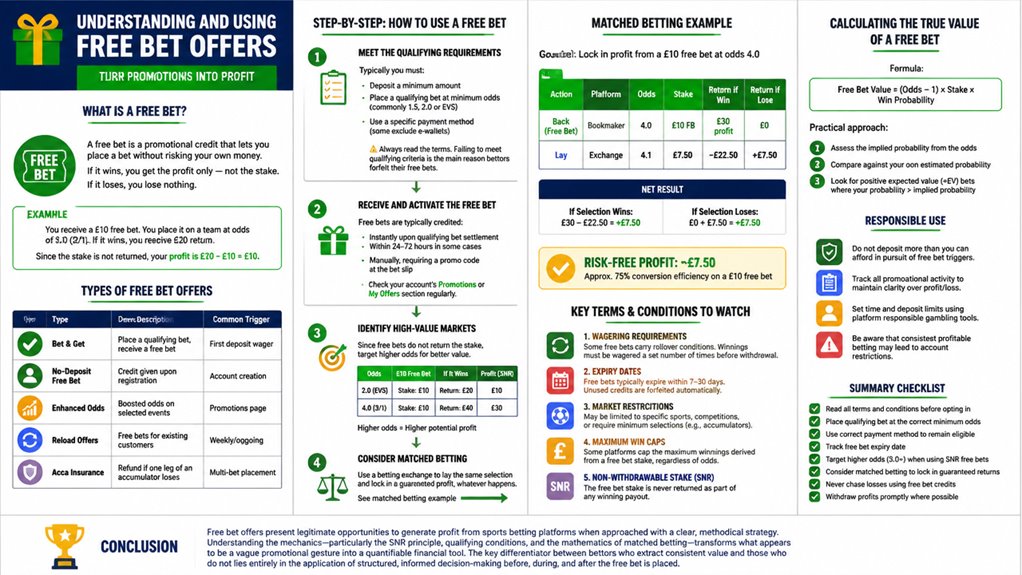
A free bet is a promotional credit issued by sportsbooks that permits bettors to place wagers without risking personal funds. Unlike standard wagers, only the profit generated is paid out—the original stake is forfeited upon settlement. This structure fundamentally shapes free bet strategies, as understanding the stake-not-returned mechanic directly influences how bettors approach selection and odds targeting.
Some variants return the original stake alongside winnings, offering greater flexibility. Regardless of type, the core principle remains consistent: bettors gain market access without capital exposure. Maximizing returns depends on recognizing this distinction early. A $50 free bet placed at +300 yields $150 in profit, not $200 as a cash wager would. Precision in understanding this mechanism separates informed bettors from those who leave value unrealized.
Stake-Not-Returned vs. Stake-Returned: Key Differences
The distinction between stake-not-returned and stake-returned free bets determines the actual cash value a bettor extracts from any given promotion.
Stake not returned advantages emerge when targeting longer odds, as profit potential scales significantly. Stake returned strategies favor conservative bettors who prioritize recovering capital regardless of outcome.
Consider these structural differences:
- SNR at +300: A $50 free bet returns $150 profit only
- SR at +300: A $50 free bet returns $200, including the original stake
- SNR optimization: Higher odds amplify extracted value disproportionately
- SR compliance: Minimum odds requirements still apply, restricting selection freedom
Bettors must analyze sportsbook terms carefully. Selecting the wrong free bet structure against one’s risk tolerance directly reduces extractable monetary value from promotions.
How to Claim a Free Bet Offer?
Understanding free bet structures is only part of the equation — knowing how to claim these offers determines whether a bettor can access that value in the first place. The sign up process typically requires creating a new account, making a qualifying deposit, and placing an initial bet. No-deposit offers bypass this, delivering small betting credits immediately after registration. Deposit-match promotions release credits incrementally as wagers are placed. Existing customers can access free bets through loyalty programs, rewarding continued engagement. Regardless of offer type, eligibility criteria govern access — these frequently specify minimum deposit thresholds, qualifying bet odds, maximum winnings caps, and expiration windows. Bettors who bypass the terms risk forfeiting credits entirely. Precision in reading promotional conditions is not optional; it is the determining factor in successfully securing value.
Wagering Requirements and Restrictions You Need to Know
Virtually every free bet carries embedded conditions that directly govern how, when, and where it can be used. Understanding these parameters is foundational to sound wagering strategies and meaningful bonus optimization.
- Minimum odds thresholds typically range from -200 to -300, restricting eligible wagers
- Expiration windows span 7 to 30 days, after which unused bets are permanently forfeited
- Usage structure varies—some bets require a single lump-sum wager; others permit splitting across multiple bets
- Market restrictions limit eligible sports and event types depending on the specific promotion
Bettors who neglect the fine print surrender advantages unnecessarily. Reviewing each offer’s terms before placing any wager guarantees no restrictions go undetected and no value is inadvertently abandoned.
What Are the Best Odds to Use a Free Bet On?
Selecting ideal odds transforms a free bet from a marginal promotional token into a genuinely high-value opportunity. Best betting with free bets centers on targeting odds between +200 and +500, maximizing returns on stake-not-returned promotions. Odds at +300 or higher consistently deliver superior value calculations.
Risk assessment demands avoiding heavy favorites priced below -200, as minimal returns effectively waste the promotional credit. Moderate underdogs present a more favorable expected value equation, balancing realistic winning probability against meaningful payout potential.
Before placing any wager, bettors must verify minimum odds requirements embedded within free bet terms. Failing to meet these thresholds disqualifies potential winnings entirely. Strategic selection at qualifying odds levels, combined with disciplined expected value analysis, converts a standard promotional offer into measurable long-term advantage.
How to Hedge a Free Bet for Guaranteed Cash?
Bet hedging is a strategy that involves placing wagers on opposing outcomes of the same event to secure a guaranteed return regardless of the result. To execute this with a free bet, a bettor places the free bet on one outcome, then places a corresponding cash bet on the opposing outcome, effectively locking in a profit margin derived from the free bet’s value. Maximizing returns through this method requires targeting free bet odds in the +200 to +400 range, as higher payouts from the free bet side offset the cash bet’s cost and produce the strongest guaranteed profit conversion rate.
What is Bet Hedging?
Hedging is a risk management strategy that involves placing opposing bets to guarantee a profit regardless of the outcome — a particularly effective technique when converting free bets into real cash. Understanding hedging strategies allows bettors to eliminate uncertainty, transforming speculative opportunities into calculated financial gains. Betting psychology plays a vital role, as disciplined execution prevents emotional decision-making from undermining profitability.
- Opposing bets are placed simultaneously across two outcomes, neutralizing risk entirely
- Free bets provide the foundational stake, meaning personal capital exposure remains minimal
- Conversion rates of 70-80% of the free bet’s value are achievable through precise hedging
- Target odds between +200 and +400 maximize the guaranteed profit margin when hedging correctly
Step-By-Step Hedging Process
Executing a free bet hedge begins with identifying an outcome that carries odds of +200 or higher, as this range maximizes the guaranteed return during conversion. Once identified, place the free bet on that selection. Simultaneously, conduct an odds comparison across sportsbooks to locate the best available price on the opposing outcome, then place a cash stake on that side. The cash wager size should be calibrated to balance both potential payouts, creating a near-neutral risk position. This betting strategy requires verifying minimum odds qualifications before placing either bet, as promotions typically impose restrictions between -200 and -300. After both bets are confirmed, monitor outcomes to validate that the hedge produced a guaranteed cash return or meaningfully reduced exposure.
Maximizing Guaranteed Profit Returns
Once the step-by-step hedging process is understood, the focus shifts to extracting maximum guaranteed profit from a free bet. Effective profit strategies rely on precise bet combinations that convert free bet value into real cash efficiently.
- Target a 70-80% conversion rate by pairing longer free bet odds with shorter cash bet odds
- Place a $100 free bet at +200 odds, then hedge $50 against that outcome at -150 odds
- Verify minimum odds requirements before executing any hedging position to maintain promotional eligibility
- Utilize sportsbooks permitting split free bet allocations, enabling hedges across multiple outcomes simultaneously
Strategic bet combinations eliminate dependence on a single outcome. The objective is not winning outright but systematically locking in predictable returns regardless of which result materializes.
How Much Is a Free Bet Actually Worth?
A free bet’s face value rarely reflects its true worth, as sportsbooks withhold the original stake upon winning, meaning only the profit is retained as withdrawable cash. The odds at which a free bet is placed directly determine its real value — a $100 free bet at +300 yields $300 in profit, whereas the same bet placed at -200 returns a mere $50. To maximize returns, bettors should target odds of +300 or higher, as this threshold significantly increases the expected value extracted from the free bet while reducing the cost of missed opportunity.
Face Value vs. Real Value
Free bets carry a face value that rarely reflects their true worth, as the actual return depends heavily on the odds at which they are placed. Strategic placement and thorough odds evaluation are critical to extracting maximum value from these promotions.
- Ideal odds for stake-not-returned free bets typically start at +300 or higher
- A $100 free bet at -200 odds yields only $50 profit, while +500 odds returns $500
- Poorly placed free bets can convert at less than half their stated face value
- Expiration dates and minimum odds restrictions further reduce accessible value
Bettors who approach free bets analytically—prioritizing favorable odds over convenient selections—consistently extract greater returns, transforming what appears to be a fixed promotional value into a genuinely flexible financial opportunity.
Odds Impact on Worth
The odds attached to a free bet are the single most consequential variable in determining its actual cash worth. Effective odds evaluation separates informed bettors from those who squander potential value.
| Odds | $100 Free Bet Return | Cash Value Retained |
|---|---|---|
| -200 | $50 | $50 |
| +150 | $150 | $60 |
| +300 | $400 | ~$75 |
| +500 | $600 | ~$83 |
| +1000 | $1,100 | ~$91 |
Since free bets follow a stake-not-returned model, only profits matter. A sound betting strategy targets odds of +300 or higher, where retained cash value increases meaningfully. Lower odds functionally diminish the free bet’s worth, surrendering advantage that belongs entirely to the bettor.
Maximizing Free Bet Returns
How much a free bet is actually worth depends almost entirely on where it is placed on the odds spectrum. Effective betting with free bets requires deliberate placement, particularly at odds of +300 or higher, where maximum value is extracted.
Key free bet strategies include:
- Targeting odds of +300 or higher to maximize cash-equivalent returns
- Avoiding heavy favorites, as short odds significantly diminish a free bet’s value
- Reviewing all terms including minimum odds requirements and expiration dates before placing
- Employing hedging techniques to convert free bets into guaranteed cash regardless of outcome
Strategic bettors treat free bets as financial instruments rather than casual wagers. Precise placement across favorable odds transforms what appears to be a promotional gimmick into a legitimate, value-generating opportunity.
Converting Free Bets to Withdrawable Cash
Converting a free bet into withdrawable cash requires understanding a fundamental limitation: only the profit generated from a winning free bet can be withdrawn, not the stake itself. This stake-not-returned model defines all profit maximization strategies worth considering.
Effective bet selection criteria center on targeting odds of +300 or higher, as heightened odds generate proportionally greater returns from a fixed free bet stake. Hedging opposing outcomes across platforms further secures realized profit, reducing exposure to total loss.
Bettors must also monitor expiration windows, typically ranging from 7 to 30 days. Unused free bets are forfeited permanently once expired, eliminating any conversion opportunity entirely. Strategic deployment—combining prime odds selection with disciplined timing—remains the most reliable method for extracting genuine, withdrawable value from a free bet.
Free Bets vs. Other Sportsbook Promotions
Free bets represent one category within a broader ecosystem of sportsbook promotions, each structured with distinct mechanics and trade-offs. Understanding these differences is foundational to developing effective free bet strategies.
- Free bets deliver immediate value without requiring deposited funds to be rolled over
- Deposit bonuses return both stake and profit but impose complex wagering requirements
- Risk free betting through no-deposit offers carries simpler activation with fewer restrictions
- Deposit bonuses offer larger potential payouts but demand greater strategic planning
Bettors who analyze these structural differences gain autonomy over their wagering decisions. Free bets favor quick, low-friction opportunities, while deposit bonuses reward patience and calculated approaches. Distinguishing free bets from matched bets or risk free betting promotions allows bettors to allocate each offer where it generates maximum independent value.
Common Free Bet Mistakes That Cost You Money
Bettors frequently forfeit value through three preventable errors: allowing free bets to expire unused, neglecting to review terms and conditions, and wagering on heavy favorites. Most free bets carry validity windows of 7 to 30 days, and failure to monitor these deadlines results in direct financial loss. Compounding this, ignoring minimum odds requirements or betting on low-odds favorites effectively neutralizes the intrinsic value of the promotion, reducing potential returns to negligible levels.
Letting Free Bets Expire
Allowing a free bet to expire unused represents one of the most straightforward yet costly mistakes a bettor can make. Most free bets carry validity periods between 7 and 30 days, creating wasted opportunities for those who fail to set expiration reminders.
- Free bets vanish completely once their validity window closes, with no recovery options available
- Single-use promotional funds demand timely action, as delays eliminate potential winning advantage
- Sportsbooks impose strict minimum odds requirements that must be satisfied before expiration
- Comparing multiple sportsbooks guarantees bettors identify the most favorable terms before time runs out
Disciplined bettors treat free bet deadlines with the same urgency as financial obligations, systematically tracking promotional windows to extract maximum value before expiration renders the offer worthless.
Ignoring Terms and Conditions
Overlooking the terms and conditions attached to free bets ranks among the most financially damaging errors a bettor can commit. Bonus eligibility hinges on meeting minimum odds requirements, typically ranging from -200 to -300; failing these thresholds results in immediate disqualification. Promotional strategies must account for sport-specific and market-specific restrictions, as sportsbooks routinely limit which wagers qualify. Certain free bets mandate splitting stakes across multiple wagers—misreading this structure eliminates viable betting opportunities entirely. Expiration windows, typically spanning seven to thirty days, further compress decision-making timelines. Bettors who approach free bets without thoroughly analyzing attached conditions surrender their autonomy over potential returns. Independent, informed engagement with every clause transforms free bets from arbitrary promotional tools into genuinely exploitable financial instruments.
Betting on Heavy Favorites
Wagering free bets on heavy favorites represents a structurally flawed strategy that systematically erodes conversion value. Favorite risks compound when stake-not-returned mechanics apply — a $100 free bet at -200 yields only $50 profit, while +300 odds return $300. Value analysis consistently reveals that odds of +200 or higher maximize expected returns.
Key strategic insights:
- Heavy favorites inflate win probability while suppressing payout potential, creating negative EV scenarios
- Free bet mechanics amplify losses on favorites since only profit is retained
- Targeting underdogs at +200 or higher dramatically increases cash conversion rates
- Most bettors overlook how favorite risks fundamentally undermine free bet optimization
Redirecting free bets toward underdogs preserves capital efficiency and unlocks substantially greater financial freedom from promotional opportunities.